
use back button to return to your test results
Understanding Your Biometric Test Results
Cholesterol is a type of fat that travels around in everyone’s blood. Having Cholesterol in your blood is totally normal. The healthy amount for an individual varies in different races of people across the world and from person to person within that race. In the Western world we have identified levels above which people’s risk of heart disease tends to increase. These levels are:
Under 5.2 mmol/l = Normal
5.2 to 6.2 mmol/l = Raised
Over 6.2 mmol/l = High
On its own, a high blood cholesterol does NOT mean you are at risk of heart disease but alongside other tests results it can help to paint a picture.
High cholesterol levels affect different population groups disproportionately. For example, high cholesterol seems to have a significant aging effect on young and middle-aged men. The effect is much less significant for older men, and for women of all ages. Low-density lipoprotein (LDL) cholesterol is less important than high-density lipoprotein (HDL) cholesterol for women of all ages, and for men over the age of sixty-five. That means that for most of us, it is more important to have high HDL than low LDL. Estrogen (the female sex hormone) generally decreases the presence of cholesterol in the blood, whereas androgens (the male sex hormones) increase blood LDL cholesterol. Premenopausal women rarely have to worry about their cholesterol levels.
HDL Cholesterol (High Density Lipoproteins)
HDL Cholesterol is one sub-type of cholesterol. Having sufficient amounts is considered important in an overall risk profile for heart disease. The normal levels are:
Over 1.5 mmol/l = Normal
Women: 1.3 to 1.5; Men 1 to 1.5 mmol/l = Low
Women: under 1.3; Men under 1 mmol/l = Very Low
Your blood pressure tells us the strength which is necessary for your heart to pump and how much resistance there is to the flow of blood in your system. The first and highest ‘systolic’ reading is the maximum pressure needed to get blood where it is needed. If your arteries are hardened or tense then this reading will start to rise. A high reading from hardened arteries will remain high no matter when or how often it is taken. A high reading from tension may fluctuate depending on transient disease or the person’s mental state. The lower ‘diastolic’ reading describes the pressure needed to keep the vascular system in equilibrium and thus how much back pressure there is. The range to look out for is:
Below 90 / 60 = Hypotension
100 / 65 = Low Normal
120 / 80 = Normal
130 / 85 = High Normal
140 / 90 = Borderline Hypertension
160 / 100 = Hypertension (Requires Treatment)
The speed at which your heart beats is dependent upon its size, its ability to function properly and the demands of your body for blood and nutrients. If you have a large heart (proportional to your body size) then it will tend to beat more slowly. The heart of an athlete is often larger and therefore beats more slowly simply through training. Taking all other factors about your body into account the speed, strength and quality of you pulse can be a useful measure of the demands of your cardiovascular system and the organs it supplies. The range for a person of average build and health is:
Under 60 beats per min = Good
60 to 70 beats per min = Normal
70 to 80 beats per min = Fast
Over 80 beat per min = Heart possibly under strain
Your BMI is used to assess whether you are overweight or underweight for your height. Being underweight can predispose to certain diseases, lead to infertility and make certain nutrients less available. Being overweight can predispose you to heart disease, type II diabetes, certain cancers, depression and many other conditions. The range is:
Under 18.5 = Underweight
18.5 to 24.9 = Normal
25 to 29.9 = Overweight
Over 30 = Obese
Your waist to hip ratio is a tool that helps you determine your overall health risk. People with more weight around their waist (apple shapes) are at greater risk of lifestyle related diseases such as heart disease and diabetes than those with weight around their hips (pear shapes).
Male Female
0.95 or below 0.80 or below Low Risk
0.96 to 1.0 0.81 to 0.85 Moderate Risk
1.0 or over 0.85 or over High Risk
A rough calculation of body fat can be made using your BMI, age and sex. It should be used alongside other measurements to help determine healthy body weight. The calculation is Adult body fat % = (1.20 x BMI) + (0.23 x Age) - (10.8 x sex) - 5.4 where sex is 1 for males and 0 for females.
Classification Women (% fat) Men (% fat)
Essential Fat 10-12.9% 2-5.9%
Athletic 14-20.9% 6-13.9%
Fit 21-24.9% 14-17.9%
Normal 25-31.9% 18-25.9%
Obese 32.0 % + 26.0 % +
Listening to your heart with a stethoscope can reveal whether the heart is beating normally and whether the valves of the heart are letting blood pass in a regular manner. Faulty valves can make it hard for your heart to pump blood to your lungs and organs forcing it to work harder and thus be under strain.
Your fasting blood glucose (you need to have not eaten for 8 to 12 hours prior to the test) is a measure of your body’s ability to maintain a normal blood sugar level. Too much sugar in the blood can lead to a number of health complications so excess sugar is normally put away in muscles or fat cells. When your blood sugar level is high it is an indication that either your pancreas is unable to secrete insulin properly or your cells are no longer taking up the sugar properly. Either way consistently high readings will eventually lead to type II diabetes. The range is:
3.9 to 5.5 mmol/l = Normal
5.6 to 7.0 mmol/l = Prediabetes or Impaired Glucose Tolerance
Over 7.0 mmol/l = Diagnosis of Diabetes
Your BMR calculates your basic calorie needs, i.e. your energy usage no matter what you're doing, (even when sleeping). Your BMR decreases as you age. Likewise, depriving yourself of food (or dieting) also decreases your BMR. Cardiovascular exercise can increase your BMR.
The only factor this calculation omits is lean body mass and thus the ratio of muscle-to-fat your body has, (leaner bodies need more calories than less lean ones). Therefore, this equation will be accurate in all but the very muscular (will underestimate calorie needs) and the very fat (will over-estimate calorie needs).
Women: BMR = 655 + ( 9.6 x weight in kilos ) + ( 1.8 x height in cm ) - ( 4.7 x age in years )
Men: BMR = 66 + ( 13.7 x weight in kilos ) + ( 5 x height in cm ) - ( 6.8 x age in years )
To determine your total daily calorie needs, simply multiply your BMR by the appropriate activity factor, as follows:
If you are sedentary (little or no exercise) : Calorie-Calculation = BMR x 1.2
If you are lightly active (light exercise/sports 1-3 days/week) : Calorie-Calculation = BMR x 1.375
If you are moderatetely active (moderate exercise/sports 3-5 days/week) : Calorie-Calculation = BMR x 1.55
If you are very active (hard exercise/sports 6-7 days a week) : Calorie-Calculation = BMR x 1.725
If you are extra active (very hard exercise/sports & physical job or 2x training) : Calorie-Calculation = BMR x 1.9
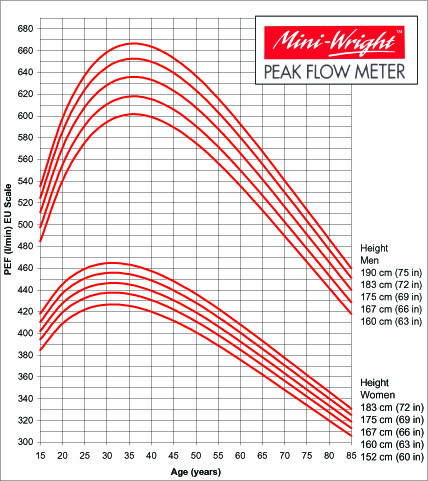
This test measures how much air you can expel in one fast out breath. It is thus a good relative indicator of lung health. People with chronic lung disease or asthma will find it more difficult to expel air. These readings are most useful when compared with a person’s past readings. Normal ranges are:
Measuring the amount of rib expansion at the fourth rib, from maximum exhale to maximum inhale is a test of both lung function and also normal rib movement. The result should be within 2.5 cm of the following normal ranges:

Using a stethoscope to listen to the lungs can identify fluid or obstruction in the lung fields, usually the sign of a chronic obstructive lung problem.
Urine reagent strips can help identify a number of metabolic problems including liver and kidney disorders, sugar metabolism, acid-base issues and infections.
Glucose: Should not be detected in the urine. Presence is a sign of abnormally raised blood glucose or abnormal take up by the kidneys
Protein: A morning specimen is best. Presence can indicate hyper tension, pre-eclampsia, glomerulonephritis, infection or diabetes.
pH: Detects general health issues effecting acid-base balance
Leukocytes: Can signify infection
Nitrites: Best taken first thing in the morning this can indicate infection
Ketones: Produced by the breakdown of fatty acids these can be an indicator of uncontrolled diabetes or anorexia
Bilirubin: May indicate biliary disease or if Urobilinogen also present may help to confirm liver disease
Blood: Presence indicates possible infection, kidney stones, injury to the urinary tract or kidneys or malignancy
Urobilinogen: Indicates liver abnormalities or red blood cell breakdown
Specific Gravity: If the density of urine is elevated this can signify diseases where dehydration results such as glycosuria, renal artery stenosis, heart failure (secondary to decreased blood flow to the kidneys), inappropriate antidiuretic hormone secretion and proteinuria. It can also be due to low water consumption.
Everyone has a different body with different strengths and weaknesses. The ability to withstand the stresses of our modern life often depends on how much time our ancestors had to adapt to these stresses and evolve mechanisms to protect us against them. Different races of people, because of their ancestor’s different lifestyles and environments, thus often have higher or lower risks of some illnesses.
Similarly some families have certain genetic traits that make them more or less susceptible to certain illnesses. Having a blood relative with certain illnesses can increase the risk that you are susceptible too. Of course this does NOT mean that you are more likely to contract the illness, it just means that if you expose yourself to the same lifestyle stresses then you will probably not be able to stand as much stress as someone else. Staying healthy can thus obliterate the predisposition.
As well as race and familial traits, other factors outside of your control such as your sex and age, plus factors that are difficult to change such as your living and working environment can also make you more susceptible to certain illnesses.
The risks shown in this part of your dashboard are thus possible amplifiers of the risk indicators and test results. If you have an amber or red light in this section then you should be taking the corresponding test results even more seriously.